How our pricing works
How our pricing works
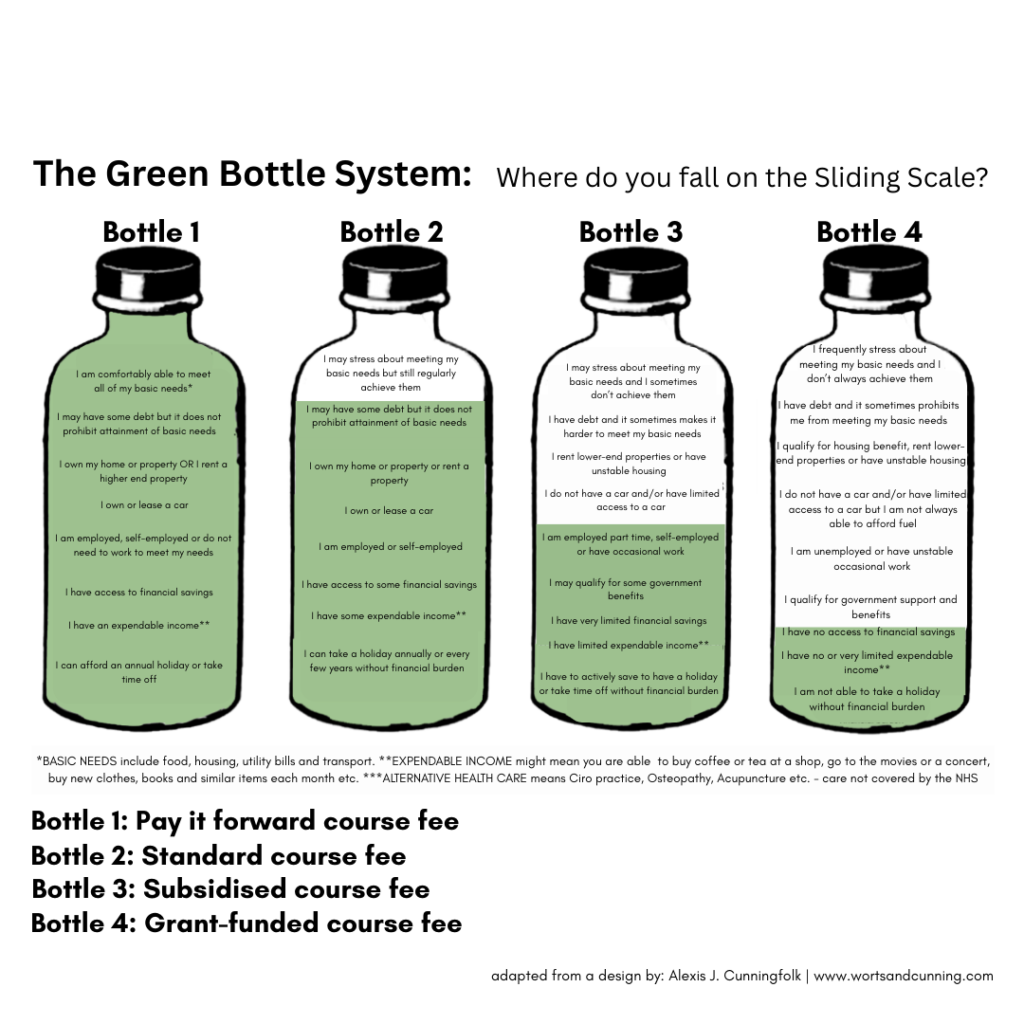
Our pricing aims to help as many women as possible to access our training.
As women, we can at times experience economic uncertainty. We would like to let you know that our sliding scale exists to support you.
Please also consider: Taking a practical skills course is an investment in Future You. Learning how to build and fix things, solve problems and tackle your own home DIY are ways to build resilience in uncertain times.
Our sliding scale works on a solidarity and trust model: those who are able to pay at the higher end help subsidise places at the lower end. There are many factors of inequity that influence an individual’s ability to pay. For a sliding scale to work it relies on the principles of truthfulness, respect for complexity, and accountability.
In addition to our sliding scale model, we have set up a ‘Bursary Fund for Women on Low Incomes‘, in case the lower end of the sliding scale options would still prohibit you from taking part. If this applies to you, please get in touch so we can explore how best to support your access to our courses.
Whenever possible, we also apply for external funding to provide practical skills training for women who are unemployed or on probation. If you are currently unemployed, please contact us and we can add you to our waiting list for future funded courses.
The true cost of a course is around the middle of the scale, the standard course fee. It needs to cover all of our overheads like insurance, workshop rent, utility bills, vehicle costs, course materials, course tools, consumables and tools breakages, course administration, and of course a fair wage for our tutors.
Sacrifice versus hardship
When choosing how much to pay please also consider the idea of sacrifice versus hardship:
Sacrifice: “If paying for a class, product, or service would be difficult, but not detrimental, it qualifies as a sacrifice. You might have to cut back on other spending in your life (such as going out to dinner, buying coffee, or a new outfit), but this will not have a long term harmful impact on your life. It is a sacred sacrifice in order to pursue something you are called to do.”
Hardship: “If, however, paying for a class, product, or service would lead to a harmful impact on your life, such as not being able to put food on the table, pay rent, or pay for your transportation to get to work, then you are dealing with hardship. Women coming from a space of hardship typically qualify for the lower end of the sliding scale.” (- Alexis J. Cunningfolk)